
Share
Working at ESO
Are you interested in working in areas of frontline technology and in a stimulating international environment? Do you feel your profile matches our requirements? Learn more about our current vacancies and apply online. Read more..



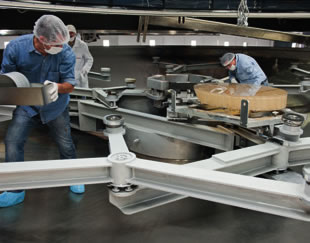
The European Organisation for Astronomical Research in the Southern Hemisphere (ESO) is the foremost intergovernmental astronomy organisation in Europe and the world's most productive ground-based astronomical observatory. ESO carries out an ambitious programme focused on the design, construction and operation of powerful ground-based observing facilities enabling astronomers to make important scientific discoveries.
ESO operates three unique world-class observing sites in northern Chile: La Silla, Paranal and Chajnantor (home to ALMA and APEX), and the ESO Headquarters are located in Garching, near Munich, Germany. At Paranal, ESO operates the Very Large Telescope, the world's most advanced visible-light astronomical observatory, and will host and operate the southern array of the Cherenkov Telescope Array, the world's largest and most sensitive high energy gamma-ray observatory. ESO is a major partner in ALMA, the largest astronomical project in existence. And on Cerro Armazones, ESO is building the 39-metre Extremely Large Telescope (ELT), which will become "the world's biggest eye on the sky" and whose operations will be fully integrated into the Paranal Observatory.
As a leader in shaping the future of ground-based astronomy, the European Southern Observatory (ESO) takes an active role in training the next generation of engineers and astronomers. The new National Engineering Graduate Trainee Scheme is a vital element of this strategy which provides recent graduates with on-the- job training opportunities working alongside senior staff who are experts in their fields. Belgium, one of ESO founding member states, has jumped on the opportunity to support this scheme and is pleased to open the position of
Belgian National Engineering Graduate Trainee Scheme
Garching
Deadline 29/07/2026
Candidates are kindly requested not to apply via the ESO career portal. Applications must be submitted directly to BELSPO as described below. Any applications received through the ESO portal will be disregarded.
As a young graduate trainee, you will have the opportunity to be involved directly in the construction of the Extremely Large Telescope (ELT) and of the next generation of instruments for the ELT, for the Very Large Telescope (VLT) and for its Interferometer (VLTI). This includes the design, development, and testing of systems and sub-systems at ESO in Garching near Munich, Germany, and their integration in the observatories in Chile. The engineering disciplines cover optical, mechanical, electronics, software as well as systems engineering. Some development project examples include the Phasing & Diagnostics Station (PDS), the Next Generation Detector Controllers (NGC-II), the Wavefront sensing cameras (WFS), the Laser Guide Stars (LGS), and the liquid nitrogen distribution infrastructure at the observatories.
What are we looking for?
Recent engineering or applied science graduates of Belgian nationality with great motivation in pushing the telescope & instrumentation technologies to their limits, as well as with desire to be part of the international team which is building, testing and operating the most powerful astronomical facilities on the Earth.
The following domains are of interest to ESO:
- System Engineering
- Software Engineering
- Control Engineering
- Electronic Engineering
- Mechanical Engineering
- Optical Engineering
- Research and Technology Development Projects
- Operations Engineering
- Civil Engineering
- Electrical engineering
Current hot topics of engagement:
- Artificial Intelligence (Large Languages Models) applied to software development, information retrieval, requirements management, automation of documentation and optimized operation & maintenance processes.
- Machine Learning (ML) applied to large data set analyses (e.g., predictive maintenance, optimized control in adaptive optics, weather forecast, image analysis for hardware inspections, automatic data reduction of calibration and scientific data to remove artefacts, systematics, and instrument biases).
- Advanced digital tools customization with Machine Learning support for maintenance, inventory and spare parts management for large projects like the ELT.
- Use of AI agents to develop Soft Real Time Cluster software (executable, GUIs, configuration), based on the library already developed for the ELT (RTC Toolkit).
- Participation to the integration and verification phase of the ELT in Chile in various engineering disciplines incl. the mechanical assembly of more than 800 mirrors with their supporting structures, their micrometric optical alignment, their accurate automatic position control (electronics and software), the arcsecond-precise pointing of a 4600 ton structure, and the compensation of the sub-micrometric atmospheric disturbances at several hundred Hertz.
- Systems engineering of such a complex system of systems, including the maintenance of the work breakdown structures, product trees, interfaces and configuration control of tens of thousands of precise, high-technology sub-systems.
- Design, development, installation and testing of advanced electronics systems including PCBs (Printed Circuit Boards), PLCs (Programmable Logic Controllers) and high-speed low-noise read-out systems for advanced optical & infrared detectors.
- Several Research & Development (R&D) activities to look into new technologies for future telescopes and astronomical instruments, and to experiment on laboratory test-benches, in the fields of quantum optics, photonics, interferometry, integrated optics, optical and infrared detectors, deformable mirrors ...
- Development of end-to-end simulators and numerical models for detectors and full astronomical instruments.
- Performing electromagnetic compliance tests and interference studies.
- Designing, manufacturing and implementing mechanisms to automate current manual maintenance activities.
- Software development to migrate the old VLT software to the new DevOps infrastructure designed for the ELT (alignment of the technologies, development in Linux environment, deployment, configuration management, automatic test environment, virtual machines, C++ and Python).
- Reliability, Availability and Maintainability (RAM) and hazard analyses on astronomical.
Qualification and Experience:
- A master's degree in engineering or Applied Sciences or a PhD graduated from 2024 at the earliest.
- An interest and basic knowledge in one of the hot topic examples listed above.
- Team player, critical & analytic thinking, ability to work on own initiative & autonomously.
Language Skills:
A good command of English is required.
Nationality:
This programme is limited to Belgian nationals.
Remuneration and Contract:
The duration of the contract will be 1 year renewable once, subject to satisfactory performance evaluation by ESO. More information on the remuneration and other benefits is available on the Belspo website (http://bit.ly/4f4vDEe)
Duty Station:
The duty station could be the ESO Headquarters in Garching near Munich, Germany (with possible duty trips to all ESO sites in Chile) or the Chile Observatories.
How to apply?
Please visit the Belspo website (https://bit.ly/4vZYJMb) and send a full application including:
- Curriculum Vitae.
- Motivation letter.
- Copies of university transcript and certificate(s) or diploma(s).
- Copies of a Belgian ID or passport.
- Summary of the candidate's master's thesis project (if applicable) and ongoing projects, indicating the title and the supervisor (maximum one page).
- The name of 3 people whom we could ask a reference letter from) to the address NEGT-AT-belspo.be
Application deadline: 29 July 2026, end of business day.
Interviews are expected to start soon after this date.
ESO Values
An important element in any successful employment relationship is harmony in values between an organisation and its people.
The ESO Values are:
ESO strives for excellence through innovation.
ESO provides outstanding services to its communities.
ESO fosters diversity & inclusion.
ESO believes in the key role of sustainability for its future.
Achieving the above are recognized as only possible on the basis of personal values and attitudes that we expect from our employees: respect, integrity, accountability, commitment, collaboration, and clear & open communication.
Applicants to any ESO role are asked to reflect on their affinity with these values and advised they may be asked about them if called for interview.
Diversity
ESO has established diversity as an important value of the Organisation, is committed to providing an equal opportunities environment and is actively seeking to promote a diverse, equitable and inclusive workforce. Please visit https://www.eso.org/public/about-eso/sustainability/dei-at-eso/ for further details.
Nationality
No nationality is in principle excluded from employment at ESO, however, recruitment preference will be given to nationals of our Member States, host states and strategic partners: Australia, Austria, Belgium, the Czech Republic, Denmark, Finland, France, Germany, Ireland, Italy, the Netherlands, Poland, Portugal, Spain, Sweden, Switzerland, the United Kingdom and Chile, irrespective of gender, age, disability, sexual orientation, ethnicity or religion.