
Share
Working at ESO
Are you interested in working in areas of frontline technology and in a stimulating international environment? Do you feel your profile matches our requirements? Learn more about our current vacancies and apply online. Read more..
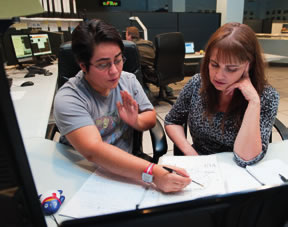
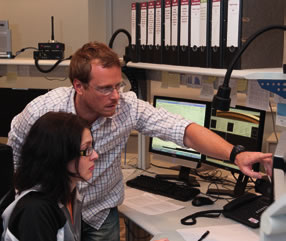

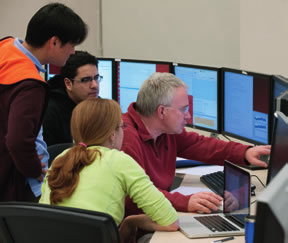


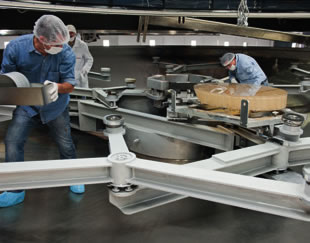
The European Organisation for Astronomical Research in the Southern Hemisphere (ESO) is the foremost intergovernmental astronomy organisation in Europe and the world's most productive ground-based astronomical observatory. ESO carries out an ambitious programme focused on the design, construction and operation of powerful ground-based observing facilities enabling astronomers to make important scientific discoveries.
ESO operates three unique world-class observing sites in northern Chile: La Silla, Paranal and Chajnantor (home to ALMA), and the ESO Headquarters are located in Garching, near Munich, Germany.
At Paranal, ESO operates the Very Large Telescope, the world's most advanced visible-light astronomical observatory, and will host and operate the southern array of the Cherenkov Telescope Array, the world's largest and most sensitive high energy gamma-ray observatory. ESO is a major partner in ALMA. On Cerro Armazones, ESO is building the 39-metre Extremely Large Telescope (ELT), which will become "the world's biggest eye on the sky" and whose operations will be fully integrated into the Paranal Observatory.
For its Science Operations Department at the Paranal Observatory in Chile, ESO opens a local staff position of:
Telescope and Instrument Operator
Paranal
Deadline 25/01/2026
The successful candidate will operate the Very Large Telescope (VLT) units as well as the smaller telescopes at Paranal observatory, together with their attached scientific instruments. The position may also involve contributions to operations development within the Integrated Operations (IOP) Programme, which aims to integrate VLT and ELT into a single observatory. The Paranal Science Operations Department (PSO) consists of around 60 staff members of more than a dozen nationalities. PSO's mission is to produce high-quality astronomical data and to maintain or improve the scientific performance of Paranal's instruments. Telescope and Instruments Operators work in close collaboration with astronomers in performing and analysing observations.
Main Duties and Responsibilities:
- Operate the telescopes and their astronomical instruments at maximum efficiency while maintaining the safety of people and equipment.
- Drive and monitor computer-controlled equipment, make real-time decisions about scheduling and observation execution, and monitor weather conditions to protect the telescopes and instruments.
- Perform quality control of the acquired astronomical data.
- Perform basic troubleshooting of the telescopes and instruments.
- Report, track, and assist in diagnosing and resolving technical and scientific problems.
Depending on qualifications and organisational needs, the role may include participation in operations development. This may include defining, reviewing, and implementing operational procedures and documentation, monitoring and characterising instruments/systems performance, contributing to projects within the Integrated Operations (IOP) Programme.
Reports to:
Telescope Instrument Operator Group Leader
Key Competences and Experience:
We look for high motivation and strong interpersonal skills, with the ability to work effectively in multi-disciplinary teams and an interest in scientific work. An operative knowledge of LINUX/UNIX is required. Proficiency in at least one programming language (preferably python) is highly desirable.
Essential competences
- Proven ability to operate and monitor complex technical systems, preferably telescopes, scientific instruments, or equivalent industrial control systems.
- Familiarity with data acquisition systems and basic principles of quality control in scientific or technical environments.
- Capacity to identify, report, and assist in the troubleshooting of technical issues.
- Good computer literacy, including experience with Linux-based systems, command-line interfaces, and operational GUIs.
- Awareness of operational safety standards and ability to follow established procedures under variable environmental conditions.
Desirable competences
- Proficiency in at least one programming or scripting language (preferably Python)
- Understanding optical, mechanical, cryogenic, and electronic subsystems relevant to telescope and instrument operations.
- Familiarity with data analysis, maintenance activities, and preventive actions on complex systems.
- Driving license
As operations take place in the Observatory's control room, an open environment shared with astronomers and technical teams, strong soft skills are highly valued to ensure smooth collaboration in a multidisciplinary and multicultural workplace;
- Strong sense of responsibility and reliability in operating high-value scientific equipment.
- Excellent teamwork skills and ability to communicate effectively with engineers, scientists, and colleagues.
- Proactive attitude and flexibility to adapt to evolving operational procedures, technologies, and instruments.
- Commitment to continuous learning and to maintain technical competence through regular training.
Experience:
Minimum 3 years of experience operating high-technology systems, and/or working in environments requiring real-time risk assessment and decision-making are highly desirable. Experience with python programming and analysis of astronomical data is an asset.
Qualifications:
Preferably a university degree in software, electronics engineering, or natural sciences, or a superior technical degree in these areas. A background in astronomy and/or experience with adaptive optics systems is advantageous but not required.
Language Skills:
A working knowledge of English is required.
Remuneration and Contract:
We offer an attractive remuneration package including a competitive salary and comprehensive medical and educational benefits, as well as financial help in relocating your family. The initial contract is for a period of two years with the possibility of indefinite extension, subject to evaluation. The title or grade may be subject to change according to qualification and the number of years of experience.
Duty Station:
Core duties are performed at Paranal Observatory, near Antofagasta (130 km. South), Chile. The working schedule is a 7-night shift on-site, followed by 7 nights off duty. Accommodation is provided on site. Depending on operational needs and personal expertise, tasks outside of core duties may be performed at ESO's Vitacura office, or via mobile work in accordance with ESO's mobile working policies.
Career Path: IV
Application:
If you are interested in working in areas of frontline technology and in a stimulating international environment, please visit (http://www.eso.org) for further details. Applicants are invited to apply online at https://jobs.eso.org/. Applications must be completed in English and should include a motivation letter and CV.
Closing date for applications is 25 January, 2026.
ESO Values
An important element in any successful employment relationship is harmony in values between an organisation and its people.
The ESO values are:
ESO strives for excellence through innovation.
ESO provides outstanding services to its communities.
ESO fosters diversity & inclusion.
ESO believes in the key role of sustainability for its future.
Achieving the above are recognized as only possible on the basis of personal values and attitudes that we expect from our employees: respect, integrity, accountability, commitment, collaboration, and clear & open communication.
Applicants to any ESO role are asked to reflect on their affinity with these values and advised they may be asked about them if called for interview.
Diversity
ESO has established diversity as an important value of the Organisation, is committed to providing an equal opportunities environment and is actively seeking to promote a diverse, equitable and inclusive workforce. Please visit https://www.eso.org/public/about-eso/sustainability/dei-at-eso/ for further details.
Nationality
No nationality is excluded, however non-Chilean applicants must have a pertinent working permit, according to Chilean regulations, at the time of the application. The post is equally open to suitably qualified candidates irrespective of gender, age, disability, sexual orientation, ethnicity or religion.